
The main valve in a basement is usually behind something. A shelf, a boiler, a stack of paint tins left by whoever sold the house. So when a homeowner finally decides to clean the prefilter, the job begins with ten minutes of moving furniture, not with the filter.
Then the valve sticks, because it hasn't been turned since the house was built.
Then the bowl comes off and water goes everywhere. Not because anything failed. Because closing the inlet doesn't empty the housing, and it doesn't isolate the pipe downstream, which is still full and still connected to every tap in the building.
That second part is the one people forget.
What closing one valve actually does
A conventional prefilter has a single shutoff, on the inlet. Close it and three things are true:
- the supply stops coming in
- the housing is still full of water
- the outlet side is still live
Open the bowl and it drains. Air enters at the top, water leaves at the bottom, and the column sitting in the downstream pipe starts falling back through the outlet, because nothing is holding it. In a two-storey house that column is a few litres. On a long run to the water heater it is more, and it arrives carrying whatever was sitting in the pipe.
Get the geometry wrong and it becomes a siphon rather than a spill. Housing below the outlet, outlet below the taps: the bowl empties itself into the room at a steady rate and no amount of fast refitting stops it.
So a five-minute filter clean costs a main valve shutoff, a house-wide pressure drop, and a towel.
Stopping both sides at once
The housing below closes the inlet and the outlet together, from one action.
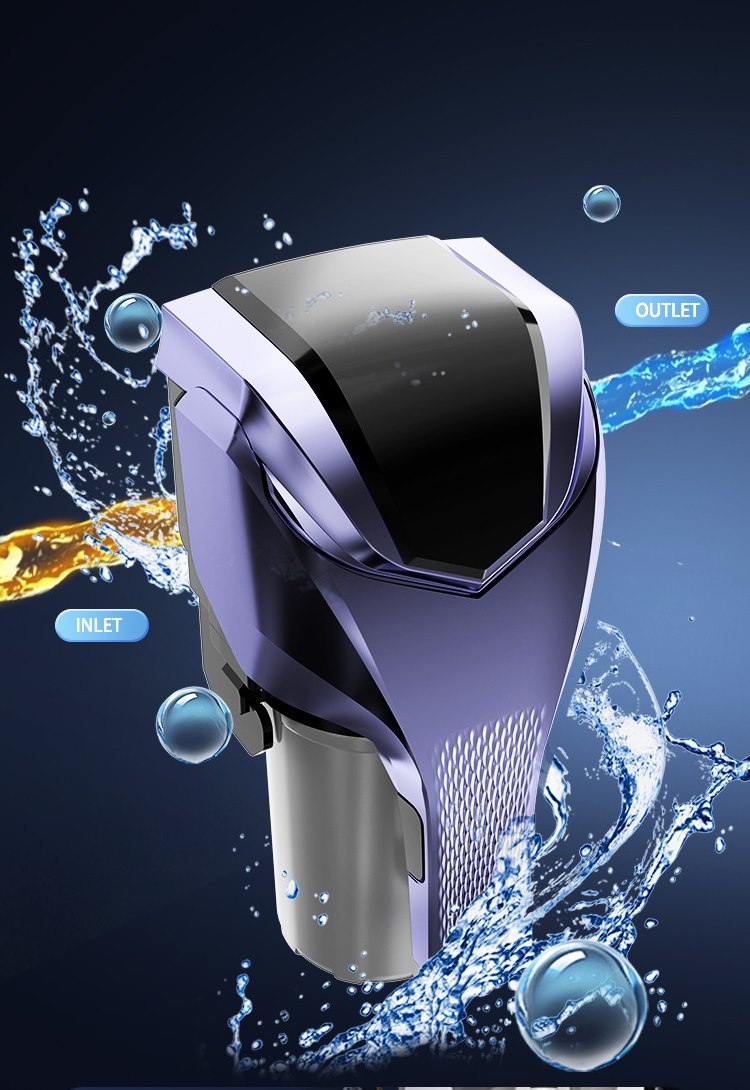
Two mechanisms, two different problems.
Inlet stop holds the supply back. Standard. Nearly every housing on the market has something that does this.
Backflow prevention holds the water on the other side. The column in the pipe, the head pressure from a roof tank, whatever is sitting downstream and looking for somewhere to go. Without it, the outlet is an open door.
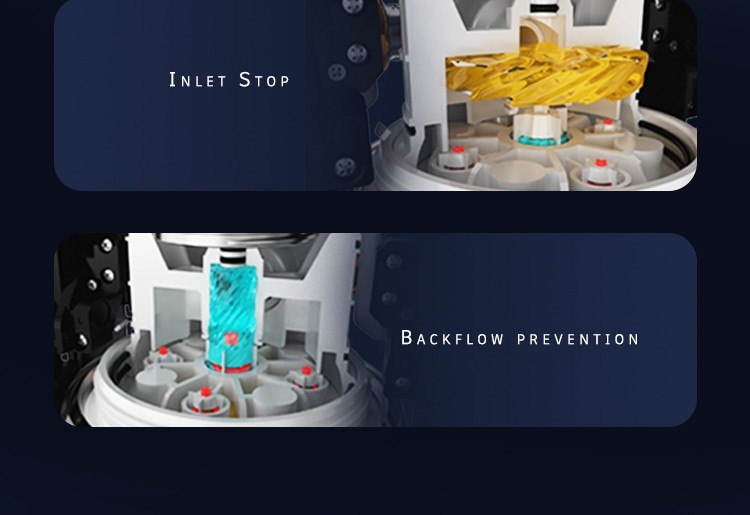
With both closed the housing is isolated. The bowl comes off dry, the water that spills is only the water that was already in the bowl, and nothing runs back. The main valve stays where it is.
That last sentence is the product, really. Not the valve. The fact that nobody has to go and find the main.
The five seconds
Quick detach is easy to claim and easy to disprove, so it's worth being exact about what the number covers.
Five seconds is the release. Twist, lift, bowl in hand. It is not five seconds for the rinse, and on a well supply with iron in it, it is not five seconds for the service either. If a supplier tells you the whole job takes five seconds, ask them to do it in front of you with dirty water in the bowl.
What the quick release changes is the decision. Cleaning a filter that needs a strap wrench, a main valve and a mop does not get done. Cleaning a filter that needs a bowl lifted out by hand, while the rest of the house keeps its water, gets done on a Sunday.
An unmaintained prefilter does not fail loudly. It loses flow slowly, and the complaint arrives eight months later as low shower pressure, at which point the screen needs to come out and that is a different, more annoying job.
360 degrees, and why retrofit work needs it
The inlet turns through a full circle, so the body can be oriented after the pipework is already fixed.
That matters in one situation, and it happens to be the most common one: an existing installation where the main drops out of the wall instead of rising out of the floor. On a fixed-direction housing the installer has two options. Stack elbows until the body points somewhere useful, and every elbow is a pressure loss plus a future leak. Or hang the unit sideways with the bowl facing a wall.
A rotating inlet removes the choice. Pipe in, body turned to where the bowl can be reached, finished.
Access is a specification item, not an installation detail. If the bowl cannot be got at, the filter will not be serviced, and a good datasheet will not save it.
One head, several cartridges
The same body takes different elements: stainless mesh for sediment, finer media where a property needs more than particle capture.
One head across the range is a dull decision with a practical payoff. The installer learns one housing. The distributor stocks one body and a shelf of cartridges. The owner replaces the element instead of the unit, and upgrades without re-plumbing.
What it is not is a licence to sell a sediment filter as a purifier. A mesh element does not remove dissolved lead, and no cartridge in this body softens hard water. When a supplier says the same housing does everything, ask which standard the claim was tested to, then look the number up.
What to check before you order
Five things, in the order they cause trouble.
- Does the outlet actually close, or only the inlet? Ask for the flow path with both closed. Inlet shutoff appears on almost every datasheet. Outlet check usually does not.
- Is the check valve serviceable? A backflow preventer that cannot be cleaned or replaced becomes the part that fails.
- What is the release mechanism rated for in cycles? Not years. A number.
- Does the inlet rotate on the production unit, or only on the sample? Tooling changes between sample and mass production more often than anyone admits in writing.
- Which cartridges fit which body, and will that list still exist in two years? Product ranges shrink. Get the commitment on paper.
Where backflow protection stops being optional
In most jurisdictions the service connection needs backflow protection, and the check inside a filter housing is not a substitute for a testable device where one is required by code. Different thing, different job.
What the housing check does is keep the service clean and dry. On a top-floor flat with a roof tank above it, or on any line where a closed valve upstream does not mean an empty pipe downstream, that is the difference between a service call and a flood.
FAQ
Can you clean a prefilter without shutting off the main valve?
Only if the housing closes both sides. With inlet-only shutoff, the bowl can be opened but the downstream line will drain back through it, so the main has to come off first.
Why does water keep running out when I open the bowl?
Because the housing is still connected to a live pipe on the outlet side. Air enters at the top, the water column behind the outlet falls back through the housing, and it keeps going until that column is empty or the outlet is closed.
Does a rotating inlet reduce flow?
A turned inlet adds one bend where a fixed housing might need three. Fewer fittings, less pressure loss, and fewer joints to leak.
Is the mesh cartridge enough on its own?
For sand, rust and pipe scale, yes. For dissolved metals, hardness or chlorine, no, and no amount of mesh will change that. Match the element to what is actually in the water.
The honest limit
Closing both sides does not make the filter maintenance-free. Sediment still has to come out, mesh still has to be rinsed, cartridges still have a service life.
What it removes is the excuse. Most prefilters are neglected because servicing one is a plumbing job, and plumbing jobs get deferred. Take the plumbing out and the neglect has nowhere to hide. Which is also how you find out, over a couple of years, whether the housing was worth buying.
If you distribute or specify whole-house filtration and want the flow path drawings, the valve specification and the cycle test behind the release, send us the market and the annual volume and we will put the file together.